
This Vintage Flower Coaster Crochet Pattern has been a really satisfying one to work up. It's quick, it's compact, and the finished result has this lovely old-fashioned quality that feels a little more special than your average coaster. If you've got an afternoon free and some yarn you've been meaning to use up, this is a pretty great way to spend it.

Jump to:
About the Design
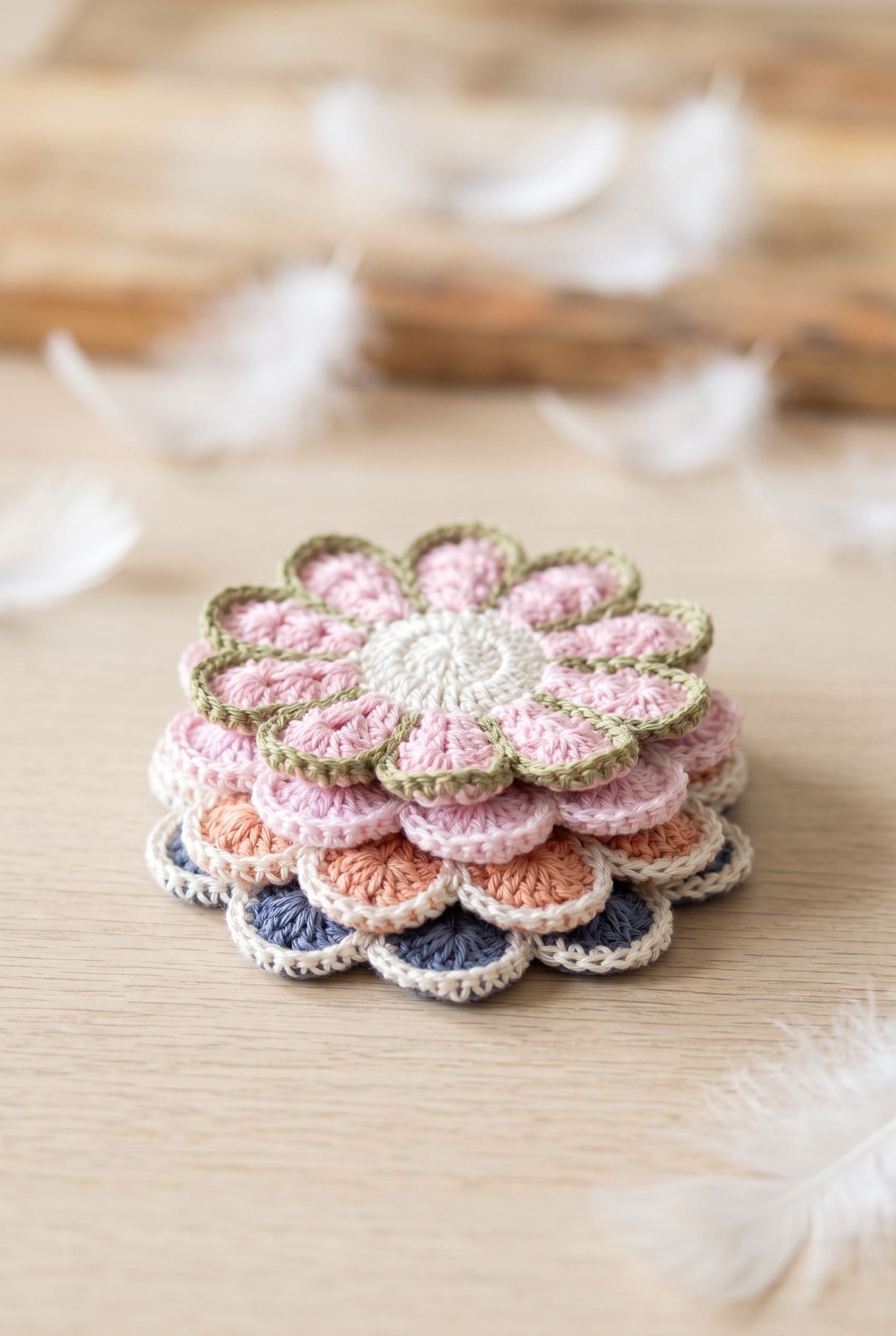
What I like about this one is that it doesn't feel like a throwaway project. Coasters can sometimes end up looking a little flat or forgettable, but the construction here gives the finished piece a real sense of dimension. The way the petals build out from the center keeps you engaged as you go, and I find that kind of rhythmic, round-by-round progress really satisfying to work through. It's the sort of thing you finish and actually want to put out on the table rather than tuck in a drawer.
I'd make a set of these for a housewarming gift without hesitation. They're small enough that a set of four or six doesn't take forever, and the vintage feel makes them land as something thoughtful rather than something dashed off. That said, they're just as nice to keep for yourself.
Why You Need This on Your Hook
A fast, easy make that actually looks like you put real effort in.
- Skill level: This is listed as easy, and it really does hold up to that label. If you're comfortable with basic stitches and working in the round, you'll have no trouble at all.
- Time investment: Each coaster works up quickly, so making a full set in a single sitting is completely doable.
- Gifting potential: A set of these makes a genuinely lovely handmade gift, especially for someone who appreciates a vintage or cottagecore aesthetic.
- Yarn usage: These are small projects, so they're a good way to use up scraps or oddments you've been holding onto.
- Technique value: Working the petals gives you good practice with building shape and structure in the round, which carries over nicely to other motif-based projects.
What You'll Need
Two small balls of fingering cotton and one hook — that's genuinely the whole list.
- Fingering Weight Mercerized Cotton (2 colors, 50 g / 136.7 yds each): Fingering weight mercerized cotton is the right call for coasters. It's firm, holds its shape after blocking, and doesn't stretch out the way acrylic does when something wet sits on it. The mercerized finish also gives the stitches a slight sheen, so the color contrast between linen and charcoal really comes through. You'll need one 50 g ball per color, which is about 136.7 yards each.
- 3.0 mm (D) Crochet Hook: A 3.0 mm hook keeps the fabric tight enough that the coaster stays flat and sturdy. Go too large and the stitches open up, which makes the whole thing floppy and less useful as an actual coaster.
- Stitch markers or sewing clips: Sewing clips are especially handy when you're holding the two petals together before seaming. They keep everything aligned so the edges don't shift around while you work the slip stitch seam.
- Also needed: darning needle, scissors
Alternative Yarn Suggestions
If you don't have fingering cotton on hand, a DK weight cotton will also work. The coaster will come out slightly bigger, and you may need to bump up one hook size to keep the tension comfortable.
- DK Weight Cotton: A standard DK cotton at around 180–200 yds per 100 g ball works well here. One ball in each color is more than enough. The finished coaster will be a bit larger and slightly thicker, which isn't a bad thing.
- Fingering Weight Cotton Blend: A fingering cotton-linen or cotton-bamboo blend is a solid option if you want a little extra drape and texture. Just make sure it's still a firm, non-stretchy blend so the coaster keeps its shape.
Color Sequence & Yarn Changes
Linen (Color A) is used for the circle section at the center, and Charcoal (Color B) takes over for the petal section starting at Round 3. The switch happens on the final yarn over of the last slip stitch in Round 2 — pull through with Charcoal instead of Linen, and the color change will be seamless with no visible jog.
At a Glance
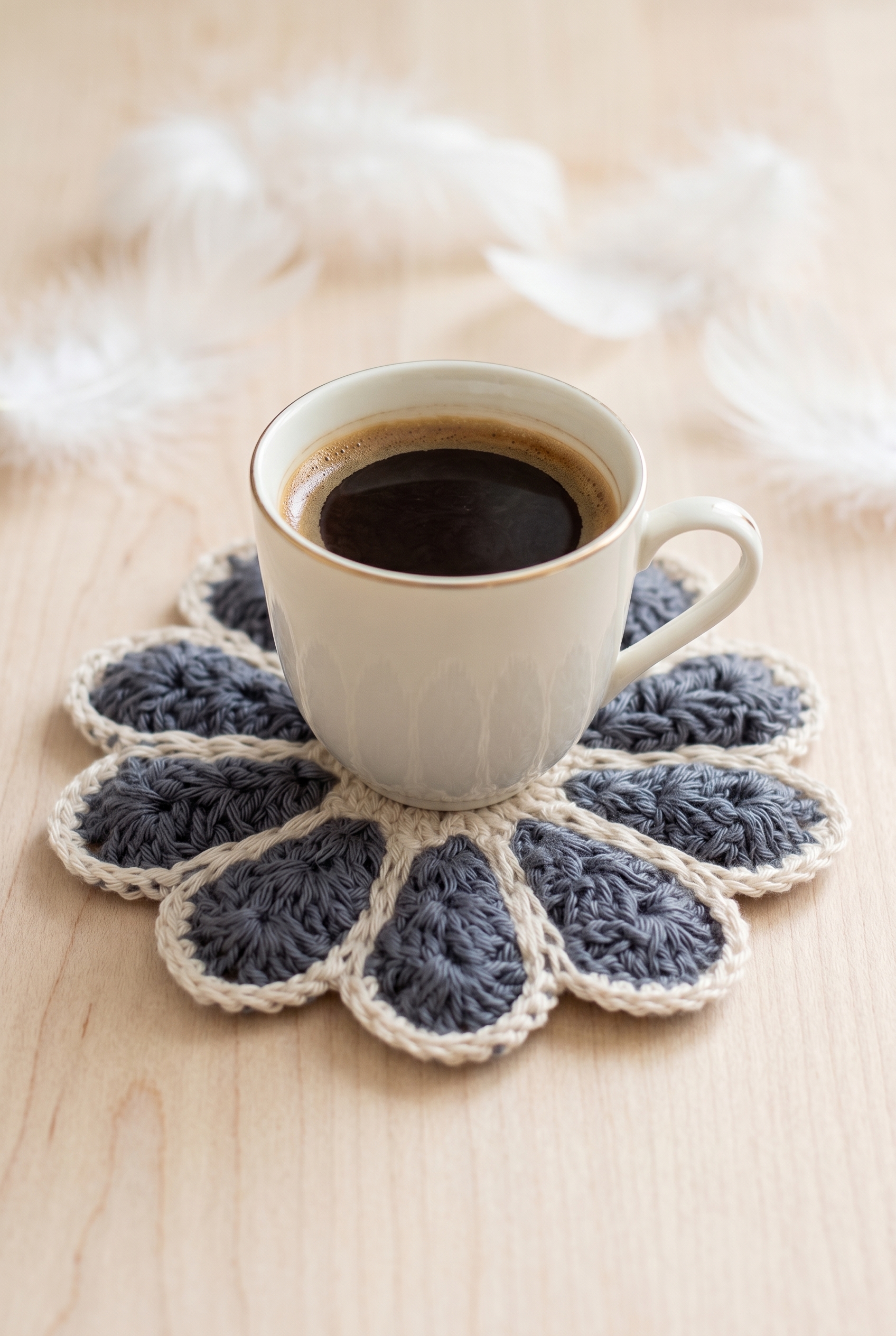
Two crocheted flower petals, seamed together into a coaster that actually lies flat.
| Skill Level | Easy |
| Pattern Gauge | Gauge is not critical for this project. Use a hook size that creates a firm fabric and a coaster size you like. |
| Finished Size | 5.5" x 5.5" (petal to petal) |
| Yarn Weight | 1 Super Fine / Fingering |
| Fiber | 100% Mercerized Cotton |
| Terminology | US |
Stitch Guide & Abbreviations
All basic stitches you've probably worked a hundred times.
- ch = chain
- dc = double crochet
- rep = repeat
- sc = single crochet
- sl st = slip stitch
- st = stitch
- yo = yarn over
Read Before Starting
This pattern is written in US crochet terms. Stitch counts per round are given in parentheses at the end of each round, so you can check your work as you go.
You'll make two flower petals separately, then seam them together to form the coaster. One petal on its own won't hold its shape — it'll be floppy. The seaming is done with slip stitches, and that part matters: keep them loose. Tight slip stitches will cause the petals to bunch and curve upward instead of lying flat.
The pattern calls for 2 colors, but 3 colors per coaster works just as well if you want more variation. For the color change between Rounds 2 and 3, switch to Charcoal on the final yarn over of the last slip stitch in Round 2. That gives you a clean, seamless transition into the new color.
If you'd rather work with DK weight yarn, that works too. Lion Brand 24/7 Cotton DK is a good option. The coaster will come out slightly larger, and you may need to go up one hook size to keep the fabric from pulling too tight.
How to Make the Vintage Flower Coaster Crochet Pattern
This vintage flower coaster crochet pattern is worked in two identical pieces that get seamed together at the end, so let's build each one from the center out.
Flower Petal: Circle Section (Color A – Linen)
You'll make two identical flower petals, and each one starts with the circle section worked in Linen. This is the center base of the coaster — a solid double crochet circle that anchors the petal rounds to come.
Round 1: With Linen, make a magic circle. Ch 3 (counts as 1 dc). Work 14 dc within magic circle. Join with sl st to 3rd ch. (15 sts)
Round 2: Ch 3 (counts as dc). Work 1 dc in same st as ch. Work 2 dc in each remaining st around. Join with sl st to 3rd ch. (30 sts) After joining, make 1 sl st in next ch, then start 1 more sl st; on the final yo of this last sl st, change to Charcoal for a seamless color change. (30 sts) The color change happens mid-slip-stitch — pull the Charcoal through on that last yarn over so the new color is ready to go when you start Round 3.
Flower Petal: Petal Section (Color B – Charcoal)
Now you're into the petal section, worked in Charcoal. These four rounds build the fan-shaped groups that give the coaster its flower silhouette, with each round expanding the clusters outward.
Round 3: Ch 4 (counts as 1 dc + ch 1). Work 1 dc in same st. *Skip 2 sts, then work (1 dc, ch 1, 1 dc) in next st, ch 1. Rep from * to last 2 sts. Sl st to 3rd ch, then 1 sl st in following space. (10 groups of (1 dc, ch 1, 1 dc)) This round establishes the 10 petal groups that all subsequent rounds will build on — make sure you're landing in the right stitch before each group.
Round 4: Ch 3 (counts as dc). Work (1 dc, ch 1, 2 dc) in ch-1 space from previous round, ch 1. *Skip next ch space, work (2 dc, ch 1, 2 dc) in following ch-1 space, ch 1. Rep from * to last ch. Sl st to 3rd ch, then 1 sl st in space from previous round. (10 groups of (2 dc, ch 1, 2 dc))
Round 5: Ch 3 (counts as dc). Work (2 dc, ch 1, 3 dc) in ch-1 space from previous round, ch 1. *Skip next ch space, work (3 dc, ch 1, 3 dc) in following ch-1 space, ch 1. Rep from * to last ch. Sl st to 3rd ch, then 2 sl st in next 2 sts. (10 groups of (3 dc, ch 1, 3 dc))
Round 6: Ch 3 (counts as dc). Work (3 dc, ch 2, 4 dc) in ch-1 space from previous round, ch 1. *Skip next ch space, work (4 dc, ch 2, 4 dc) in following ch-1 space, ch 1. Rep from * to last ch. Sl st to 3rd ch, then 3 sl st in next 3 sts. (10 groups of (4 dc, ch 2, 4 dc)) Note that the center chain space increases to ch 2 in this round — that wider space is what you'll be seaming into later.
Finish off and weave in ends. Repeat all 6 rounds to make the 2nd flower petal.
Seaming the Two Petals Together
With both petals finished, it's time to join them into a single coaster. This section works through both layers at once, so take your time lining things up before you start.
Step 1: Stack both flower petals on top of each other with the right side facing up (wrong sides facing each other).
Step 2: Place a stitch marker at the top of every 2nd group to hold the two petals together. These markers keep the layers from shifting as you work around.
Step 3: Reattach Linen yarn to the ch-2 space of any one of the groups.
Step 4: Work 4 sc in each of the 4 dc stitches of the group, making sure to insert your hook through both petals at once. Then work 1 sl st in the ch-2 space. Catching both layers on every stitch is the whole point here — if your hook is only going through one petal, the coaster won't hold together.
Step 5: Work 3 sl st going downward, one in each ch-2 space. Keep sl st loose; tight stitches will cause the groups to bunch and petals to curve upward.
Step 6: Work 1 sl st in the next stitch of the 2nd circle round, then 1 more sl st in the following stitch. Then work back upward making sl st in each ch-2 space.
Step 7: Work 4 sc in each dc stitch of the next group of 4, then work 2 sc in the ch-2 space between the groups.
Step 8: Repeat Steps 4–7 for each petal. After finishing the last petal, work 1 more sc in the space where you added your yarn and sl st to that stitch.
Step 9: Remove all stitch markers. Finish off and weave in all ends. Your crochet flower coaster is complete!
Care Instructions
Mercerized cotton holds up really well through regular washing, so these coasters can absolutely go in the machine on a gentle, cold cycle. Lay them flat to dry rather than tossing them in the dryer. The two-layer construction means they take a little longer to dry through, and heat can cause the layers to pucker unevenly. Once dry, stack them in a flat pile somewhere they won't get crushed. They stay in shape well as long as you're not folding them.
Frequently Asked Questions
Why do I need to make two petals instead of just one?
One petal on its own is too floppy to function as a coaster. Making two and seaming them together gives the finished piece enough structure to actually sit flat on a table and hold a mug. The seaming step is what pulls it all together, literally.
My petals are bunching up and curving at the edges after seaming. What went wrong?
Tight slip stitches during the seaming section are almost always the culprit. Keep your sl st loose as you work downward through the ch-2 spaces. It feels counterintuitive to leave them that relaxed, but tight stitches pull the petal groups inward and cause that upward curve. Go back and check your tension before you finish off.
When exactly do I switch from Linen to Charcoal?
The color change happens mid-slip-stitch at the very end of Round 2. After joining Round 2, work 1 sl st in the next chain, then begin 1 more sl st. On the final yarn over of that second sl st, drop Linen and pull Charcoal through. That timing gives you a seamless transition going into Round 3.
Can I use more than two colors for this coaster?
You can use up to three colors per coaster. The pattern is written for two, but adding a third color is a natural option, maybe a different shade for the center circle, the inner petal rounds, and the outer rounds. Just keep the color change method the same and you won't run into any structural issues.
How much yarn do I actually need for one coaster?
Each color comes on a 50 g / 136.7 yd skein of Scheepjes Catona. One coaster uses a small fraction of each skein, so a single skein of each color will get you through several coasters. I'd say one skein per color is more than enough for a set of four.
Can I use a heavier yarn weight for a bigger coaster?
DK weight works well for this. Lion Brand 24/7 Cotton in DK is a good option. The finished coaster will come out a bit larger than 5.5 inches, and you may want to go up one hook size to keep the fabric from pulling too tight. The structure and stitch pattern stay the same.
Before You Go
If you make a set of these, I'd love to see how your color combinations turn out. Tag me on Instagram or drop a photo in the comments. The linen and charcoal pairing is one of my favorites, but I keep thinking about how good a dusty rose and cream version would look on a kitchen table. If you want to save this for later, pin it to your crochet home decor board so it doesn't get lost in your browser tabs.
🌼 Love floral home décor? The Cherry Blossom Coaster and Lemon Fruit Coaster use the same flat-round base — make all three for a beautiful handmade coaster set. And if you enjoy flower motifs, the Rose Flower and Daisy Flower Pot patterns are worth adding to your queue too.


Leave a Reply