
I've been on a real kick lately making practical things for the kitchen, and this Kitchen Dishcloth Crochet Pattern has been a go-to for exactly that. It's a small, quick project that actually gets used, which I appreciate more than I probably should. If you've got an afternoon and some cotton yarn sitting around, you're already most of the way there.

Jump to:
About This Project
What I like about this one is how satisfying it is to finish. It's the kind of project where you cast on, get into a rhythm pretty fast, and before long you've got something genuinely useful sitting in your hands. I find that really rewarding, especially compared to longer projects where the payoff takes weeks. This is a same-day finish, and that matters sometimes.
I also think dishcloths are massively underrated as gifts. You can make a set for a housewarming, tuck one into a gift basket, or just keep a stack of them for yourself. No trouble at all to make a few extras while you're already in the groove with the pattern.
Why You'll Love This Pattern
It's a fast, easy make that actually earns its place in your home.
- Skill Level: This is rated Easy, so if you're comfortable with basic stitches, you'll move through it with no trouble.
- Quick to Finish: It's a compact project you can realistically complete in one sitting, which makes it great for when you want results fast.
- Gifting Potential: Dishcloths are practical and personal, and they make a really thoughtful addition to any handmade gift.
- Make a Set: Once you've got the pattern down, it's easy to crank out several in a row, especially if you're working with a few different colors.
- Technique Practice: The stitch pattern gives you good repetition on texture work, so it's a solid project for building confidence with that kind of construction.
Gather Your Supplies
One skein covers multiple washcloths, so you might finish this project and still have yarn left over.
- Worsted Weight Cotton Yarn: Cotton is the right call for dishcloths and washcloths. It holds up to washing, dries reasonably fast, and has enough texture to actually do the job. You'll need about 50 yards per washcloth, so one 100g skein (around 190 yards) will get you several cloths before you run out.
- 4.5 mm (G) Crochet Hook: This size pairs well with worsted cotton, giving you a fabric that's firm enough to be useful but not so tight that it's a struggle to work with.
- Also needed: darning needle, scissors
Alternative Yarn Suggestions
Worsted cotton is pretty widely available, but if you want to shop around or use something already in your stash, there are solid options out there.
- Worsted Weight Cotton-Acrylic Blend: Usually around 170-200 yards per 100g skein. The acrylic content adds a little stretch, so the finished cloth will feel slightly softer, though it won't scrub quite as well as 100% cotton.
- Worsted Weight Bamboo-Cotton Blend: Typically 190-220 yards per 100g. It's a bit drapier than straight cotton, but it's still absorbent and washes well, and the finished cloth has a nice smooth feel.
The Quick Stats
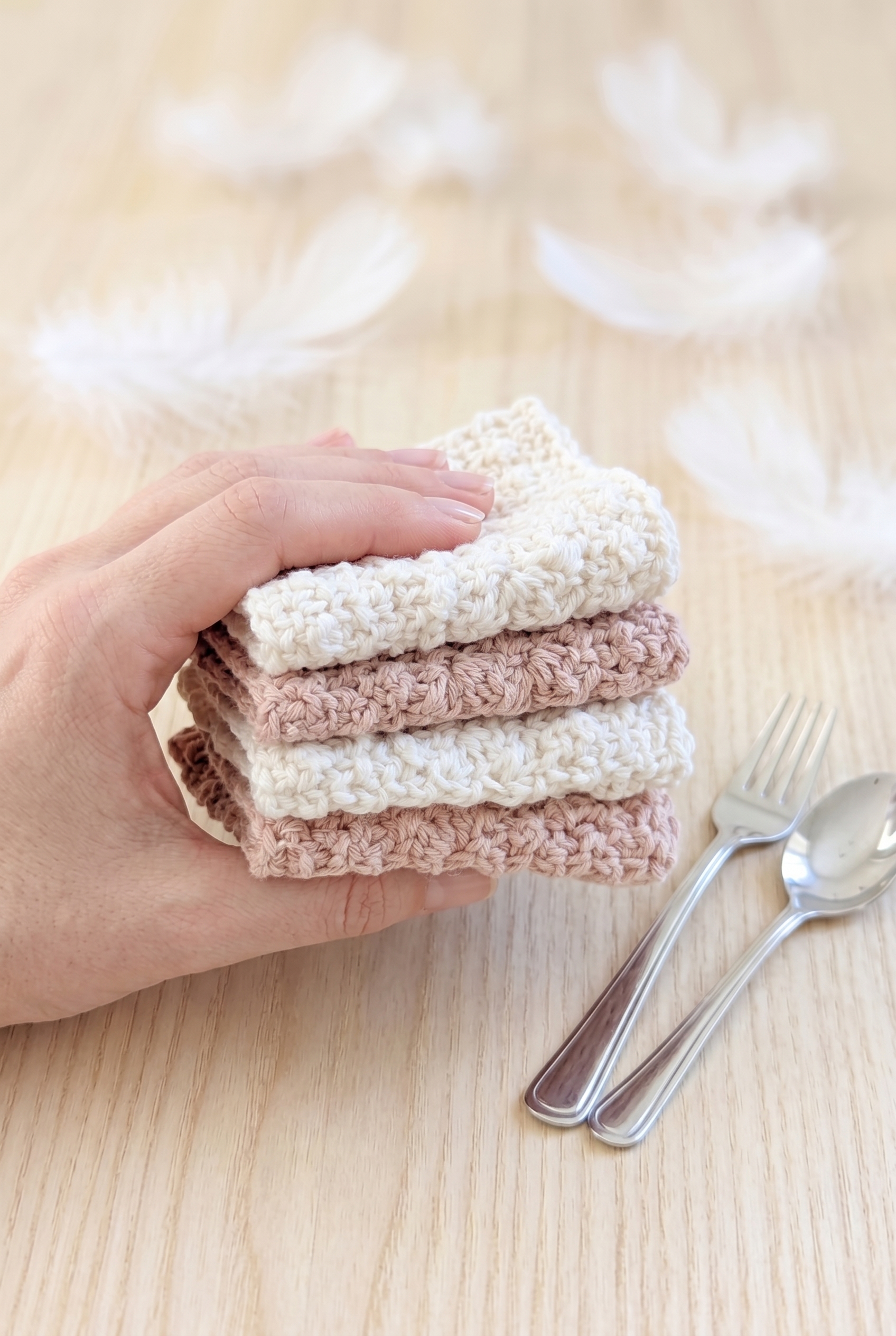
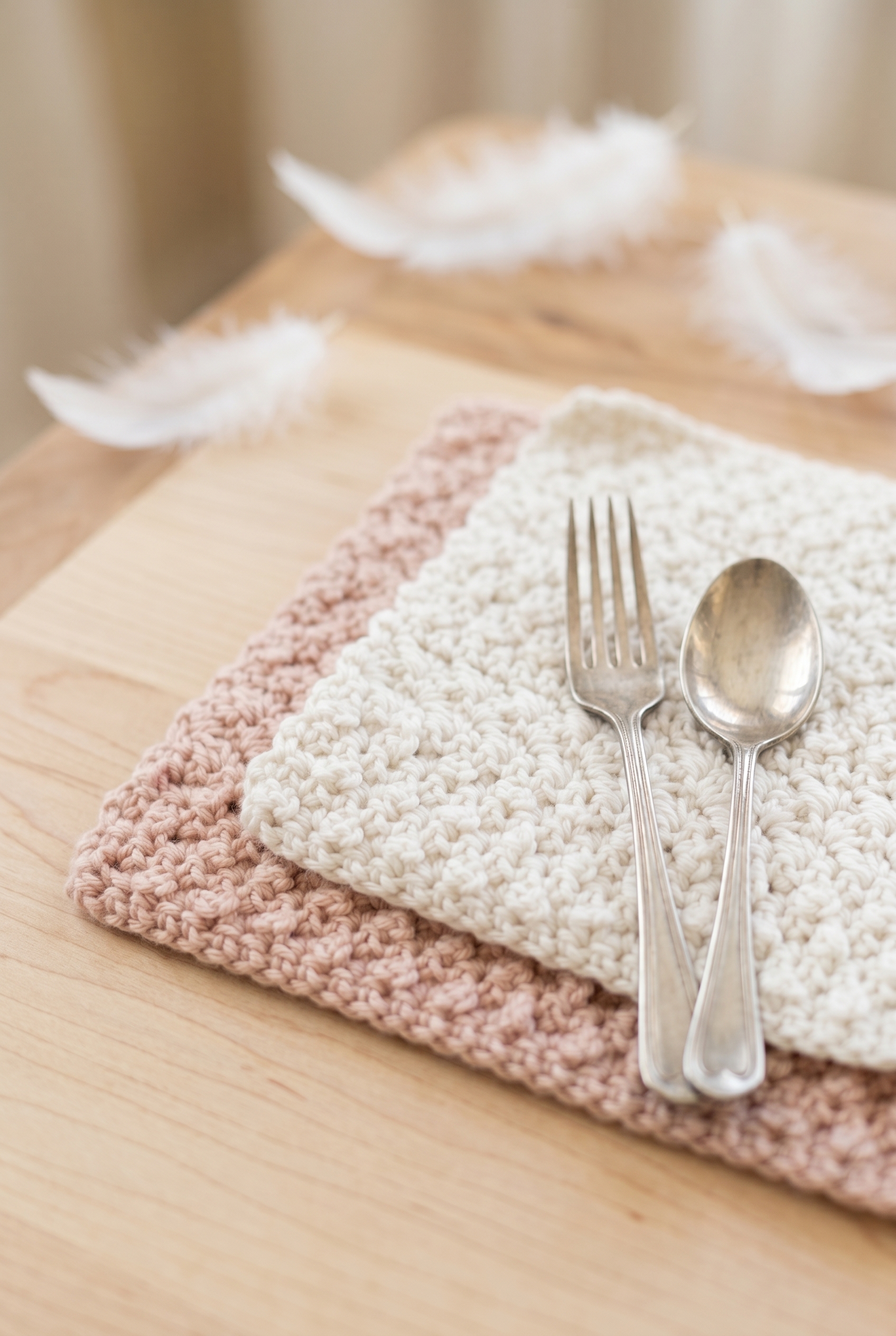
A cotton dishcloth with a little texture built in, thanks to the extended single crochet running through it.
| Skill Level | Easy |
| Pattern Gauge | 20 rows x 14 sts = 4" square |
| Finished Size | 8 ½" x 7" |
| Yarn Weight | 4 Medium / Worsted |
| Fiber | 100% Cotton |
| Terminology | US |
Stitches & Abbreviations
Short list here, mostly familiar stitches plus one extended variation.
- ch = chain
- sc = single crochet
- dc = double crochet
- eesc = extended single crochet: Insert hook in next st, yo, pull up a loop, ch 2, yo, pull through both loops on hook.
- st(s) = stitch(es)
Special Stitches
- Extended Single Crochet (eesc): Insert hook in next st, yo, pull up a loop, ch 2, yo, pull through both loops on hook.
Read Before Starting
This pattern is written in US terms and worked flat in rows. The ch 1 at the start of a row does not count as a stitch, so don't work into it at the end of the following row. Stitch counts are given in parentheses at the end of each row, which makes it easy to catch a mistake before it compounds. Gauge matters more than you might expect for a dishcloth. If your swatch is off, your finished piece will be too, and cotton doesn't have much give to fudge it.
The Pattern
Here's how I work the dishcloth from the foundation chain through all the textured sections.
Dishcloth
The dishcloth is worked flat in rows, cycling through three distinct stitch textures to build up the surface pattern. The eesc (elongated extended single crochet) rows alternate with plain sc rows and a shell-style sc/dc section, so the cloth ends up with real variety without ever being complicated to track.
Row 1: Ch 32.
Row 2: Sc in 2nd ch from hook, sc in next ch and in each ch across. (31)
Row 3: Ch 1, turn, *sc in first st, eesc in next st. Repeat from * till last two sts, eesc in next st, sc in last st. (31) This is the first textured row. The eesc stitches pull slightly longer than a standard sc, creating the raised texture across the surface.
Row 4: Ch 1, turn, sc in first st and across. (31)
Row 5: Ch 1, turn, sc in next two sts, eesc in next st. *sc in next st, eesc in next st. Repeat from * till last two sts. Sc in last two sts. (31) Notice the offset: this row starts with two plain sc before the first eesc, shifting the texture one stitch over from row 3.
Row 6: Ch 1, turn, sc in first st and across. (31)
Row 7: Repeat row 3. (31)
Row 8: Repeat row 4. (31)
Row 9: Ch 1, turn, (1 sc, 1 dc) in first st, skip next st. *(1 sc, 1 dc) in next st, skip next st. Repeat from * till last two sts. Skip next st, sc in last st. (31) This is the shell section. Each (sc, dc) pair works into a single stitch, and the following stitch gets skipped, so the stitch count stays at 31.
Row 10: Repeat row 9. (31)
Row 11: Repeat row 9. (31)
Row 12: Ch 1, turn, sc in first st and in each st across. (31) After three rows of the sc/dc pattern, this plain sc row resets the fabric before the next texture section begins.
Rows 13–18: Repeat rows 3–8. This brings back the eesc texture section in full, working the same six-row sequence you completed at the start.
Rows 19–21: Repeat row 9. Three more rows of the sc/dc shell pattern.
Row 22: Repeat row 12.
Rows 23–28: Repeat rows 3–8. The final eesc texture section, mirroring the opening of the cloth.
Row 29: Repeat row 12.
Finish off and weave in ends.
Care Instructions
Cotton is pretty forgiving, and these dishcloths can go straight into the washing machine. I toss mine in with a regular load on warm and they come out fine every time. The one thing I'd skip is the dryer on high heat, since that can shrink cotton more than you'd expect and pull the fabric a little tight. Lay them flat or hang them to dry and they'll hold their shape wash after wash.
Frequently Asked Questions
How many dishcloths can I make from one skein of Dishie?
One skein of WeCrochet Dishie is 190 yards, and each dishcloth uses about 50 yards. So you can get roughly three to four dishcloths from a single skein, which makes it a really efficient use of yarn. I usually plan for four and end up with a little left over.
What is the eesc stitch and is it hard to learn?
Eesc stands for extended extended single crochet. It creates a slightly taller stitch than a regular single crochet, and it's what gives the textured sections of this dishcloth their raised look. It takes a row or two to get the rhythm of it, but once it clicks it moves pretty quickly. If you've done a regular single crochet, you're most of the way there.
Does the ch 1 at the beginning of each row count as a stitch?
No, the ch 1 does not count as a stitch in this pattern. Your stitch count at the end of every row should be 31, and that chain is just your turning chain. It's noted in the pattern, but it's easy to forget mid-project and accidentally end up with an extra stitch.
Can I use a different cotton yarn instead of Dishie?
Any worsted weight cotton yarn will work here. The pattern calls for about 50 yards per dishcloth, so as long as your yarn is weight 4 and 100% cotton, you're set. Cotton blends can work too, but pure cotton holds up better to repeated washing and actually gets softer over time.
The pattern has three different stitch sections. Do they all repeat the same number of rows?
Not exactly. The eesc texture sections each run six rows, and the sc-dc shell sections run three rows each. They alternate throughout the pattern, which is what creates the banded look on the finished cloth. Rows 3 through 28 follow that repeating structure, with a plain single crochet row between each section.
Final Thoughts
There's something satisfying about making something you'll actually use every single day, and these dishcloths are exactly that. They work up fast, the stitch variety keeps things interesting, and a skein of Dishie in Swan or Linen gives you enough for a little set to keep by the sink. If you make a batch, I'd love to see them. Tag me on Instagram or drop a photo in the comments below. And if you want to save this for later, the Pinterest button is right there waiting for you.


Leave a Reply