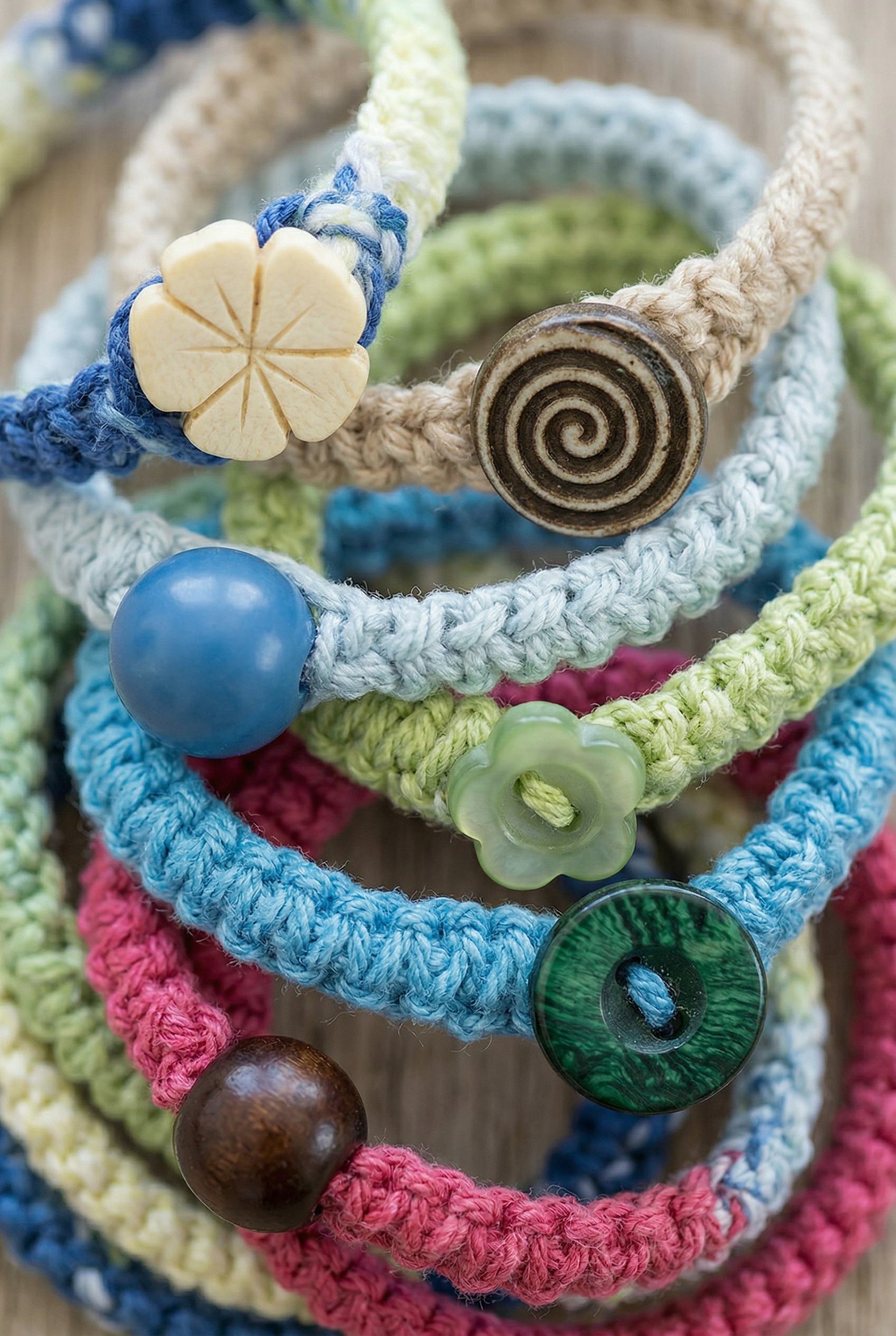
This Braid Bracelet Crochet Pattern gives you a quick, satisfying little project that results in a chunky, textured bracelet you'll actually want to wear, and it's easy enough to knock out a whole stack in an afternoon.

Jump to:
Behind the Pattern
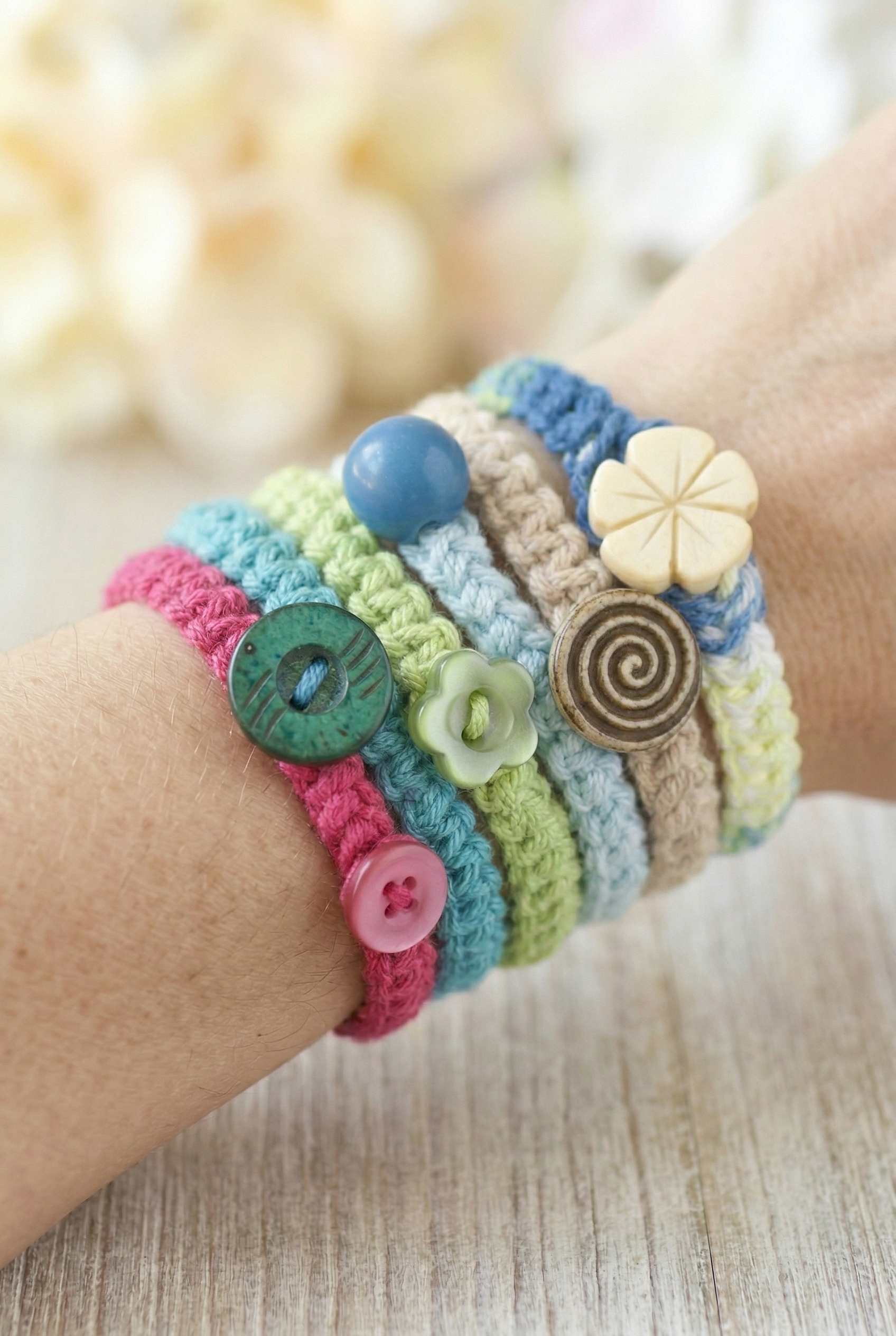
What I love about this one is how much personality fits into such a small project. The bracelets in the photo are stacked together in this really satisfying mix of colors: dark blue, pale green, cream, light blue, turquoise, and bright pink. Each one has that chunky, raised texture that makes them look way more involved than they actually are. And then the buttons. That's the part that really got me. Big, interesting buttons, a cream flower shape, a brown spiral, rounds in blue and green and dark brown. They sit right on the band and turn what could be a plain little strip into something that looks intentional and put-together.
You don't need a lot of experience to get a result you're proud of, I think. The sizing is custom, so you crochet to fit your own wrist, which means you're not stuck guessing or adjusting a fixed measurement.
Why You Need This on Your Hook
A fast, customizable bracelet you can make in multiples without getting bored.
- Custom sizing: You crochet to your actual wrist measurement, so fit is never a guessing game.
- Button closure: The button you choose does a lot of the design work, so swapping it out gives you a completely different look with the same pattern.
- Quick finish: These are small enough that you can complete one in a single sitting, which makes them perfect for gifting in batches.
What You'll Need
The supply list for this bracelet is about as short as it gets.
- DK weight mercerized cotton yarn: For this project I reach for a light weight mercerized cotton every time. The mercerization process gives the fiber a slight sheen and a smooth, firm hand that holds its shape well against the skin, which matters a lot for something worn on the wrist. You only need about 3 to 6 meters per bracelet, so this is a genuinely good use for leftover DK cotton you have sitting around.
- E US / 3.5 mm crochet hook: This size pairs well with DK cotton and gives you a fabric that's firm enough to hold structure without being stiff or uncomfortable to wear.
- Button or bead for closure: One button or bead is all you need here. The size matters more than you might think. It needs to fit snugly through the loop you'll make at the end, so hold it up against your yarn before you commit to it.
- Also needed: small tapestry needle or sewing needle, scissors
Yarn Substitutes
Mercerized cotton is worth tracking down for this one if you can, but it's not strictly required. A couple of other options work fine, so there's that.
- Non-mercerized DK cotton: Same weight, just a slightly matte finish and a softer hand. It works perfectly well and is much easier to find at a general craft store.
- Fingering weight cotton or cotton blend: If you go down to fingering weight, drop to a smaller hook, around a B or C US, and expect to use the lower end of that yardage estimate. The bracelet will come out a little more delicate looking, which some people actually prefer.
Choosing a Button
Something around half an inch to three-quarters of an inch in diameter works well, but you can go bigger since you'll crochet the loop to fit. A flat button with 2 or 4 holes sits the sleekest against the wrist. Shank-back buttons are nice too because the holes are underneath so you only see the decorative top. Wooden toggles give it a rustic feel, metal or leather if you want something more masculine, and colorful plastic works great for kids. Whatever you pick, hold it up against your yarn before you commit. If the button and the color don't look right together you'll know.
Project Summary
Here's everything you need at a glance before you pick up your hook.
| Skill Level | Level 2 — Easy |
| Pattern Gauge | Gauge is not critical for this project. Use a hook size that creates a neat, firm cord and adjust tension so the fabric is tight and sturdy. |
| Finished Size | Custom fit: crochet until the bracelet is slightly longer than the wrist measurement. |
| Yarn Weight | 3 Light / DK |
| Fiber | 100% Mercerized Cotton |
| Terminology | US |
Customizing the Size
This bracelet is sized entirely by length. Wrap the cord around your wrist as you go, or measure your wrist and keep crocheting until the bracelet is slightly longer than that number. That extra bit accounts for the overlap at the button closure. No math required beyond that.
Stitch Guide & Abbreviations
Only three stitches in this one. Keep the list close anyway.
- ch = chain
- sc = single crochet
- sl st = slip stitch
Before You Begin
A few things worth knowing before you start. Gauge doesn't matter here in the traditional sense, but hook size does affect how the finished cord looks and feels. Too loose and it gets floppy; too tight and it's hard to work into. Aim for something firm and tidy. Test as you go by wrapping the cord around your wrist. The button loop is worked as a tightly crocheted chain at the end. You won't be working back into those chain stitches, so don't worry about keeping them particularly loose. Just keep them snug and even. That's really it.
Let's Make the Braid Bracelet Crochet Pattern
Here's how I work through each part of this bracelet, from the first chain to the finished clasp.
Part 1: Crocheting the Cord
This is the main body of the bracelet, and it's worked in a continuous i-cord-style technique rather than traditional rows. Leave a 6 in/15 cm tail at the beginning — you'll use that tail later to sew on the button, so don't trim it. You'll repeat Step 3 until the cord reaches your desired length, so measure against your wrist as you go.
Start by leaving that tail, then chain 2 and work a single crochet into the second chain from the hook. From there, turn your work and sc into the horizontal bar on the side of the previous sc — this is the bar that runs along the left edge of the stitch when you're looking at it straight on. It feels a little odd the first time, but you're essentially building the cord sideways rather than in the usual direction. On the next turn, you'll sc into both horizontal bars on the side of the previous sc. That's the move that locks the cord together and gives it that neat, rounded structure. Keep turning and repeating that last step — sc into both horizontal bars on the side of the previous sc — until the cord is the length you need.
Do not fasten off yet (continue to button loop).
Part 2: Crocheting the Button Loop
The button loop grows directly from the end of the cord with no break in the yarn. One thing worth knowing before you start: the button loop is a tightly crocheted chain, and you will not be working back into these chain stitches — it's just the chain itself that forms the loop. Don't fasten off until you've confirmed the loop fits over your button, because you may need to adjust.
Chain a length long enough to pass over your button (about 6–10 ch), then turn your work once more and join with a sl st to the two horizontal bars of the final stitch. Do not fasten off yet. Then check that the button will pass through the loop. If not, undo the sl st, add one or more ch sts, then repeat the sl st under the bars of the final stitch. It's worth being patient here — a loop that's too tight won't close, and one that's too loose won't hold. Once the loop is the right size, fasten off, leaving a 4 in/10 cm yarn end.
Thread the end onto a needle, weave it down into the final stitch, and knot it around a loop of the stitch so it is securely fastened. Then pass the needle along the middle of the crocheted cord, lengthwise along the cord. Check before pulling the needle all the way through: if you have gone through the middle of the cord, the needle should not be visible on either side of the cord. Pull the needle through, pull the yarn end tight, and snip the yarn close to the surface. Running the end through the center of the cord rather than along the outside is what keeps it invisible and secure — this is the finishing method I use for both ends on this bracelet.
Fasten off, weave in ends.
Part 3: Attaching the Button
This is the last step, and it's straightforward. You're working with the starting tail you left at the very beginning of the cord.
Thread the starting tail onto a needle and sew the button to that end of the bracelet. Once the button is in place, knot the yarn firmly around a loop of the bracelet beneath the button so it is securely fastened — this knot is doing real work, so pull it snug. Then weave in the remaining end the same way you did in Part 2, Step 5: through the middle of the cord lengthwise, check that the needle isn't showing on either side, pull tight, and trim close to the surface.
Weave in ends and trim excess yarn.
Finishing & Assembly
By the time you reach this point, most of the work is already done inside the individual parts. But here's how the whole thing comes together. The button loop joins to the cord with a slip stitch worked into the two horizontal bars of the final cord stitch — that connection point is what keeps the loop from pulling loose with wear. On the other end, I sew the button (or bead, if that's what you're using) directly to the starting-tail end of the bracelet using that long beginning tail. Once the button is positioned where I want it, I knot the yarn firmly around a loop of the bracelet underneath it before weaving in. That knot is the anchor. Without it, the button can work its way loose over time no matter how carefully you've sewn it. Both yarn ends get woven through the center of the cord lengthwise and trimmed close to the surface — not along the outside edge, but through the actual middle of the cord so nothing shows and nothing catches.
Care Instructions
Because this is a wearable that'll be put on and taken off regularly, it's worth thinking about how you wash it. If you used a cotton or cotton-blend yarn, hand washing in cool water with a gentle soap is the safest route — lay it flat to dry so the cord keeps its shape. Avoid wringing it. If you used an acrylic, most are machine washable on a gentle cycle, but check your yarn label to be sure. Either way, I'd keep it away from heat, since the button or bead closure can warp or crack if it goes through a hot dryer.
Frequently Asked Questions
What hook size do you use for this bracelet?
I use a 3.5 mm hook, which is a US size E. It gives the braid texture a nice tightness without making the fabric stiff or hard to work with.
How do I know when the bracelet is long enough?
Measure your wrist and crochet until the piece is slightly longer than that measurement. The fit needs a little extra length to account for overlap at the closure, so don't stop right at your wrist size.
What yarn weight works best for this pattern?
I reach for DK weight, which is a weight 3 Light yarn. Anything heavier and the bracelet starts to feel bulky on the wrist. Lighter and you lose the definition in the braid.
Is this a good pattern if I haven't made many accessories before?
It's rated Easy, so it's not a huge undertaking. If you've made a few basic projects and you're comfortable with your tension, you should be fine. The custom sizing is the part that trips people up most, so just measure twice before you fasten off.
Can I make this bracelet as a gift in a size I don't know?
You can, but you'll need a wrist measurement to go on. A standard adult wrist runs somewhere around 6 to 7 inches, so that's a reasonable starting point if you're guessing. I'd lean toward making it a touch longer rather than shorter, since there's no easy way to add length once it's done.
Before You Go
I'd love to see what colors you choose for your braid bracelet. DK yarn comes in so many beautiful options and the color really does make or break the whole look, so don't just grab whatever's closest. If you make one, tag me on Instagram or drop a photo in the comments. I check them WAY more often than I probably should. And if you want to save this for later, pinning it to your accessories board on Pinterest is always a good call. Let me know in the comments if you made it to fit your own wrist or gifted it to someone else.
💜 More wearables to try: The Flower Headband and Flower Child Hairband use similar lightweight yarn and make a great set with this bracelet.


Leave a Reply