
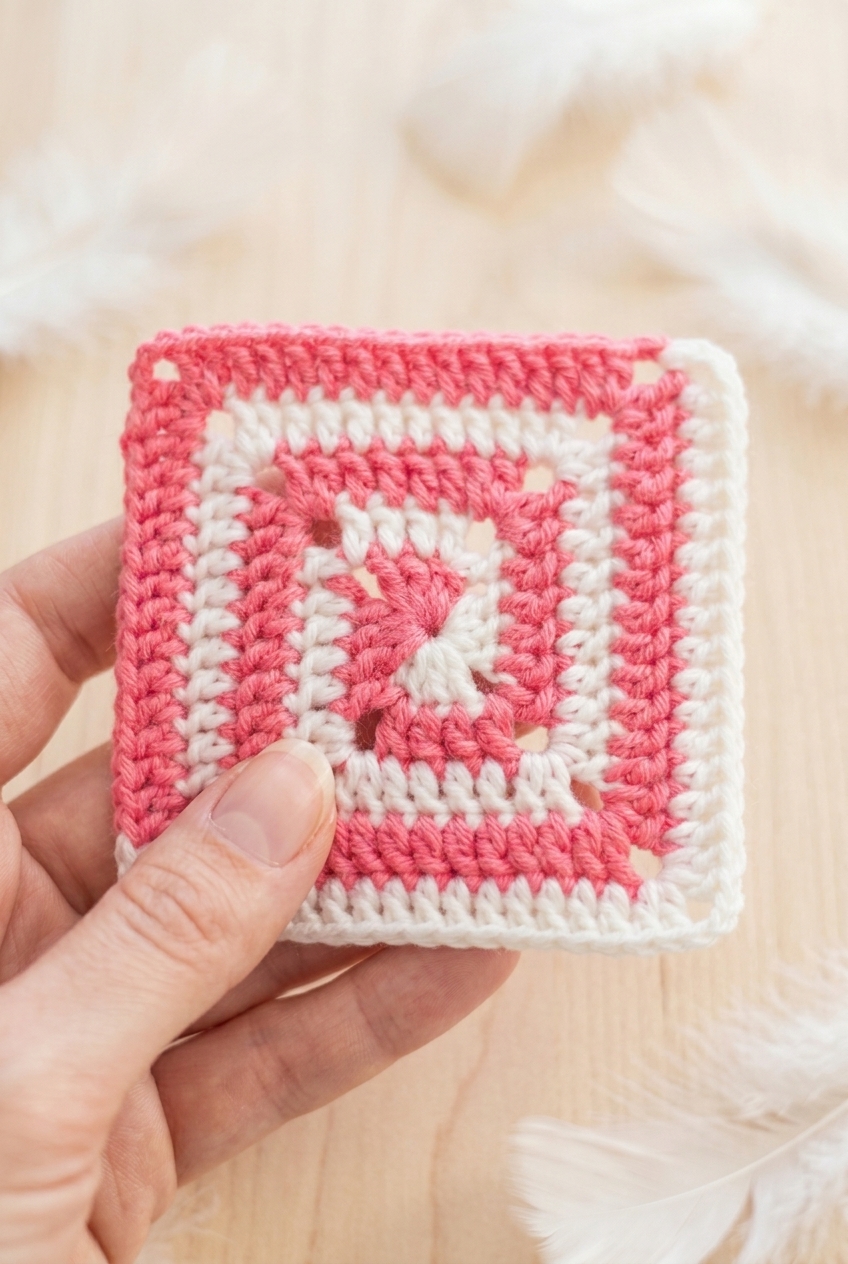
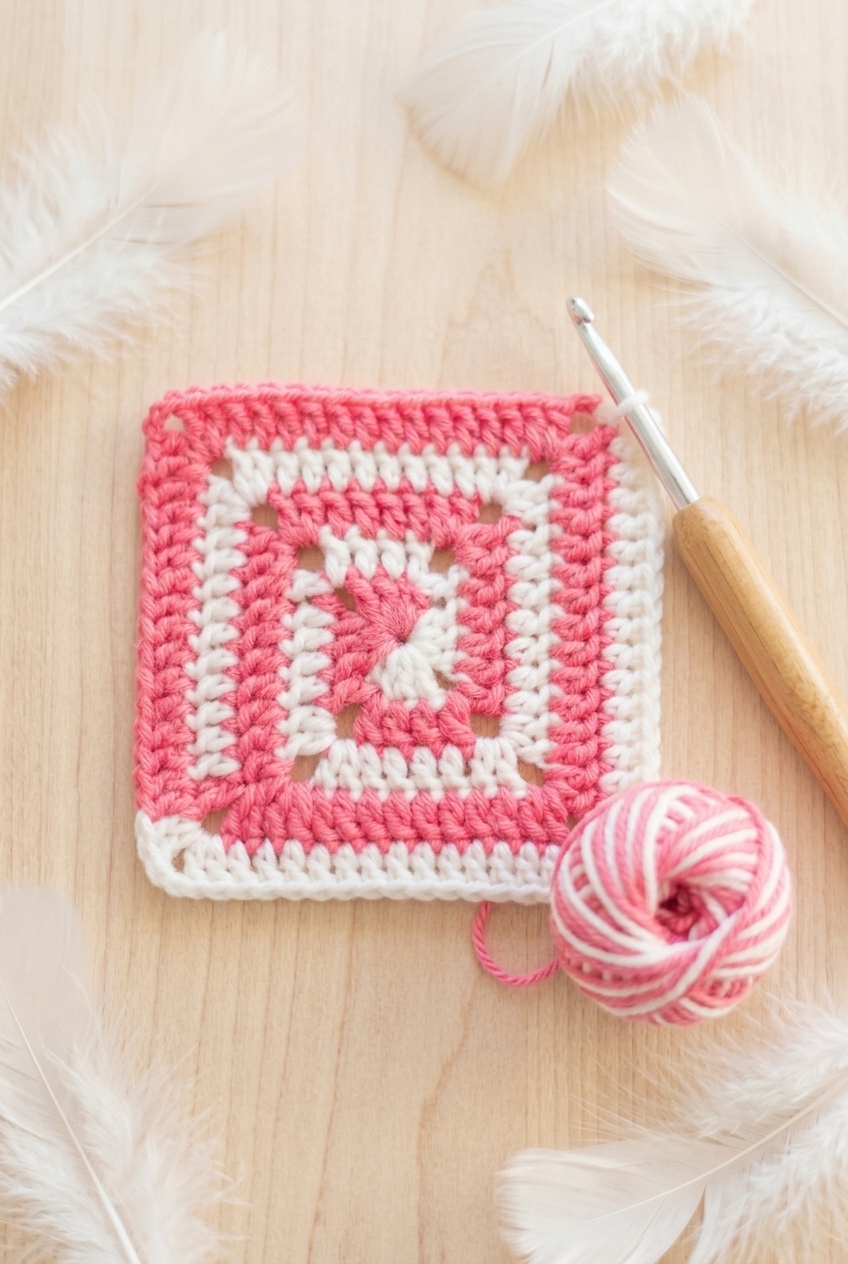
This Candy Twist Granny Square Crochet Pattern is a compact, satisfying project that works up into a neat, structured square with a really pleasing rhythm to it once you get going. It's intermediate level, so there's enough going on to keep things interesting without it turning into a whole thing.

Jump to:
The Inspiration
What I love about this one is how the construction just clicks. Granny squares have been around forever, but there's something about the way this particular motif builds outward in those concentric rounds that feels fresh. It's not just a basic granny. The stitch arrangement gives it a kind of order and intention that I find really satisfying to work through.
I'd make this for anyone who appreciates something handmade but understated. It's the kind of motif that works beautifully as part of a bigger home decor project, and it's small enough that you can knock out several in a sitting. Great for when you want to be productive but also just want something calm to work on.
Why You Need This on Your Hook
This motif is quick, structured, and genuinely fun to repeat once you find your groove.
- Skill level: Intermediate, so you'll work with cluster stitches and consistent tension without it being overwhelming.
- Time investment: Each square is small and works up fast, making it perfect for project nights or commute crafting.
- Technique value: A solid motif for practicing concentric square construction and corner spacing in a low-stakes format.
- Gifting potential: Make a stack of these and you've got the building blocks for a really thoughtful handmade home decor gift.
- Mix and match: The clean, geometric structure makes it easy to combine with other motifs or join into a larger piece.
Your Supply List
Two colors and a short notions list — that is really all you are working with here.
- DK Weight Yarn, Two Colors: DK weight sits in a nice middle ground for a project like this — fine enough to show stitch definition clearly, but not so thin that it becomes fiddly to work with. You will want two colors that contrast well, since the alternating spiral is the whole visual point. Yardage isn't specified in the original pattern notes, but for a small motif or square this size, somewhere in the range of 20 to 40 meters per color is a reasonable starting estimate. Check your stash before buying anything new.
- 3.5 mm Crochet Hook: A 3.5 mm pairs well with DK weight and keeps the fabric from getting too loose or too stiff. You want a little structure here, not a floppy result.
- Also needed: yarn needle, scissors, stitch marker
Color Sequence & Yarn Changes
Both colors are active at the same time throughout the pattern, alternating in a spiral rather than switching cleanly at the end of a round. The way it works: you drop one color, leave it waiting, and pick up the other — so both strands are hanging out in the work at once. A stitch marker on any live loop you step away from will save you a lot of grief.
Key Information
A two-color spiral granny square worked in DK weight, where both colors stay live at the same time.
| Skill Level | Intermediate |
| Pattern Gauge | Gauge is not critical for this project. Use the stated hook size (or adjust as needed) to create an even fabric and achieve the desired finished square size. |
| Finished Size | 10 cm x 10 cm |
| Yarn Weight | 3 Light / DK |
| Fiber | Not specified — check the yarn label |
| Terminology | US |
Stitches & Abbreviations
Short list — all standard stitches you've probably used before.
- ch = chain
- ch-sp = chain space
- dc = double crochet
- sl st = slip stitch
- st(s) = stitch(es)
- * * = repeat instructions between asterisks as directed
Helpful Tips
Stitch counts in the instructions reflect only the stitches made in that round. The total stitch count for the finished square is given at the very end.
The thing that makes this square a little different is that both colors are working at the same time in a spiral. You don't cut and rejoin. Instead, you drop one color, set it aside (a stitch marker through the live loop helps here), and pick up the other. It sounds fiddlier than it is once you're a round or two in.
Keep a stitch marker handy for those parked loops. Losing one means unraveling to find it, and that's not a fun detour.
The Pattern
Here's how I work the Candy Twist Granny Square, round by round.
The Granny Square
This square is worked in rounds with two colors running simultaneously in a spiral. The key thing to know before you start: you're not carrying the unused color or cutting between rounds. Instead, you remove your hook from one color's loop, set it aside with a stitch marker if needed, and re-join the other color exactly where it left off. It takes a little getting used to, but the rhythm clicks quickly once you're a round or two in.
Round 1: In Color 1: ch 4, sl st in 1st ch to form a loop, ch 1, 3 dc in center of loop, ch 3, 3 dc in center of loop, remove hook (add stitch marker if needed). Join Color 2 with ch 1, 3 dc in center of loop, ch 3, 3 dc in center of loop, remove hook (add stitch marker if needed). Re-join hook in Color 1 loop. [12 sts, not including chs]
Round 2: Color 1: [1 dc, ch 3, 1 dc] in next st, 1 dc in next 2 sts, [1 dc, ch 3, 1 dc] in next ch-3 sp, remove hook. Re-join hook in Color 2 loop: [1 dc, ch 3, 1 dc] in next st, 1 dc in next 2 sts, [1 dc, ch 3, 1 dc] in next ch-3 sp, remove hook. Re-join hook in Color 1 loop. [12 sts]
Round 3: Color 1: 1 dc in next 4 sts, [2 dc, ch 3, 2 dc] in next ch-3 sp, 1 dc in next 4 sts, [2 dc, ch 3, 2 dc] in next ch-3 sp, remove hook. Re-join hook in Color 2 loop: 1 dc in next 4 sts, [2 dc, ch 3, 2 dc] in next ch-3 sp, 1 dc in next 4 sts, [2 dc, ch 3, 2 dc] in next ch-3 sp, remove hook. Re-join hook in Color 1 loop. [32 sts]
Round 4: Color 1: 1 dc in next 7 sts, [2 dc, ch 3, 2 dc] in next ch-3 sp, 1 dc in next 8 sts, [2 dc, ch 3, 2 dc] in next ch-3 sp, remove hook. Re-join hook in Color 2 loop: 1 dc in next 7 sts, [2 dc, ch 3, 2 dc] in next ch-3 sp, 1 dc in next 8 sts, [2 dc, ch 3, 2 dc] in next ch-3 sp, remove hook. Re-join hook in Color 1 loop. [46 sts]
Round 5: Color 1: 1 dc in next 11 sts, [2 dc, ch 3, 2 dc] in next ch-3 sp, 1 dc in next 12 sts, [2 dc, ch 3, 2 dc] in next ch-3 sp, remove hook. Re-join hook in Color 2 loop: 1 dc in next 11 sts, [2 dc, ch 3, 2 dc] in next ch-3 sp, 1 dc in next 12 sts, [2 dc, ch 3, 2 dc] in next ch-3 sp, remove hook. Re-join hook in Color 1 loop. [62 sts]
Round 6: Color 1: 1 dc in next 15 sts, 1 dc in next ch-3 sp, remove hook. Re-join hook in Color 2 loop: 1 dc in next 15 sts, 1 dc in next ch-3 sp, fasten off and tie in all ends to finish. [32 sts] Note that this final round drops the corner ch-3 spaces entirely, closing the square off with straight dc across each side.
Fasten off and weave in all ends.
Frequently Asked Questions
How does the two-color spiral technique actually work in this pattern?
Both colors are worked at the same time in a spiral, but you're not carrying them together. You work a segment in Color 1, remove your hook, then pick up Color 2 and work its segment, remove that hook, and re-join Color 1 again. A stitch marker in the live loop keeps everything from unraveling while you swap. It feels a bit awkward at first, but by Round 2 it clicks.
Why does my stitch count look off in Round 6?
Round 6 is intentionally shorter than the rounds before it. Each color only works 15 dc plus 1 dc into the ch-3 space, giving you 32 stitches for that round. It's not a mistake in the pattern. The square closes out that way by design, and Color 2 fastens off at the end of Round 6 while Color 1 finishes last.
Can I use a different hook size than 3.5 mm?
You can, and your finished size will shift depending on what you use. The pattern finishes at 10 cm x 10 cm on a 3.5 mm hook with DK weight yarn. If you're making multiples to join into a larger project, consistency matters more than hitting that exact size, so just pick a hook and stick with it throughout.
Do I need to fasten off between every round?
Color 2 only fastens off once, at the very end of Round 6. For everything before that, you just remove your hook and leave the loop live while you work the other color. That's the whole point of the stitch marker: keeping that loop safe so you can come back to it without losing your place.
How many ends will I have to weave in when I'm done?
Not as many as you'd expect for a two-color project. Color 2 is joined once in Round 1 and fastened off once in Round 6, so that's two ends for that color. Color 1 starts the square and finishes last. Check your yarn label for fiber content before weaving in, since the method that works best for securing ends can vary quite a bit between fibers.
Happy Crocheting
I'd love to see what color combinations you land on for this one. The two-color spiral does something really satisfying when you pull it all together, and the color choices make such a difference in how the twist reads. If you make one, tag me on Instagram or drop a photo in the comments. And if you're planning to make a stack of these for a larger project, save this to Pinterest so you can find it again easily. Let me know below if you run into anything mid-pattern. I'm happy to help.


Leave a Reply