
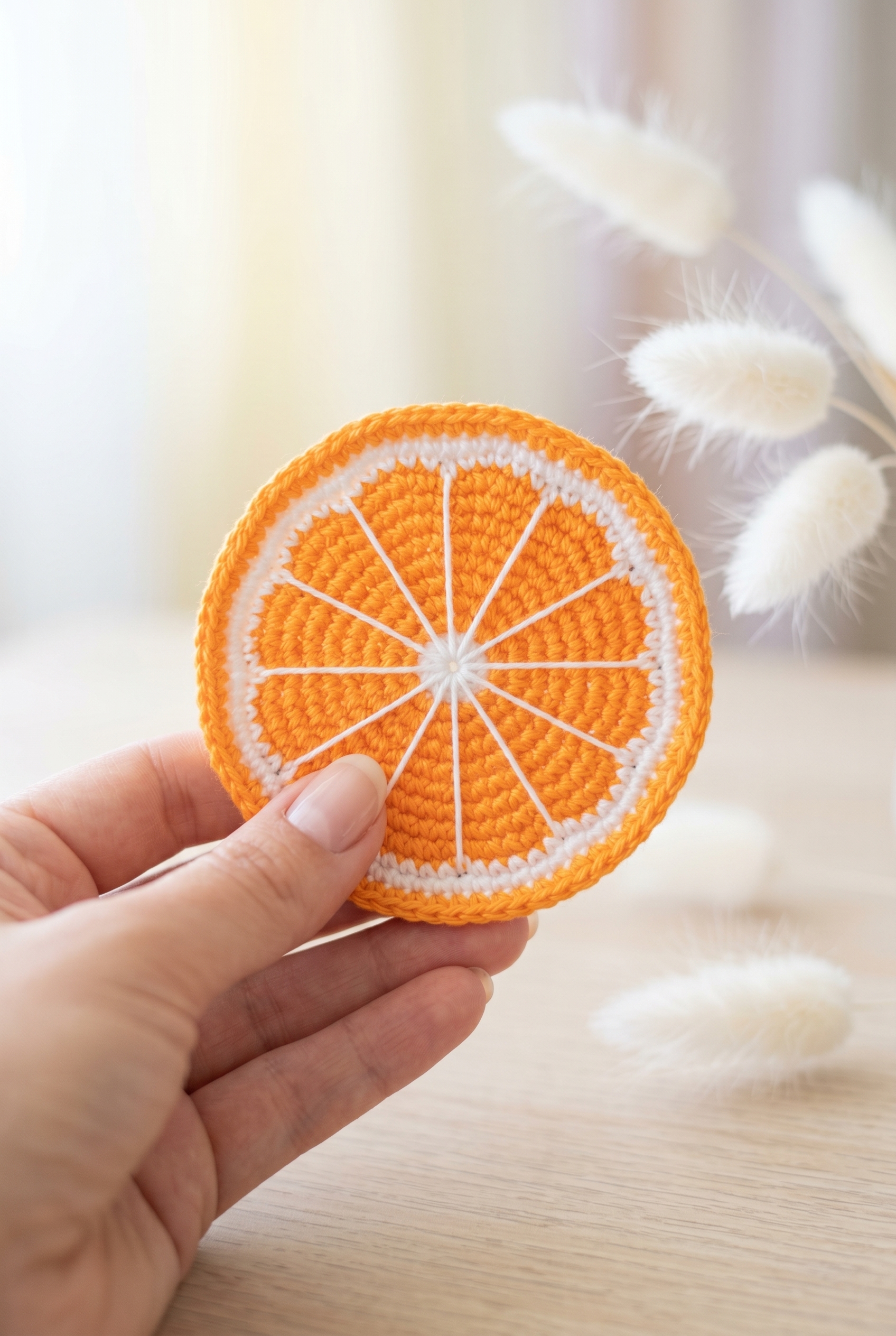
The Lemon Fruit Coaster Crochet Pattern is one of those quick makes that feels way more satisfying than you'd expect from something so small. It's a compact, crocheted round coaster designed to look like a citrus slice, and it comes together fast enough that you could knock out a whole set in a single sitting.

Jump to:
About This Project
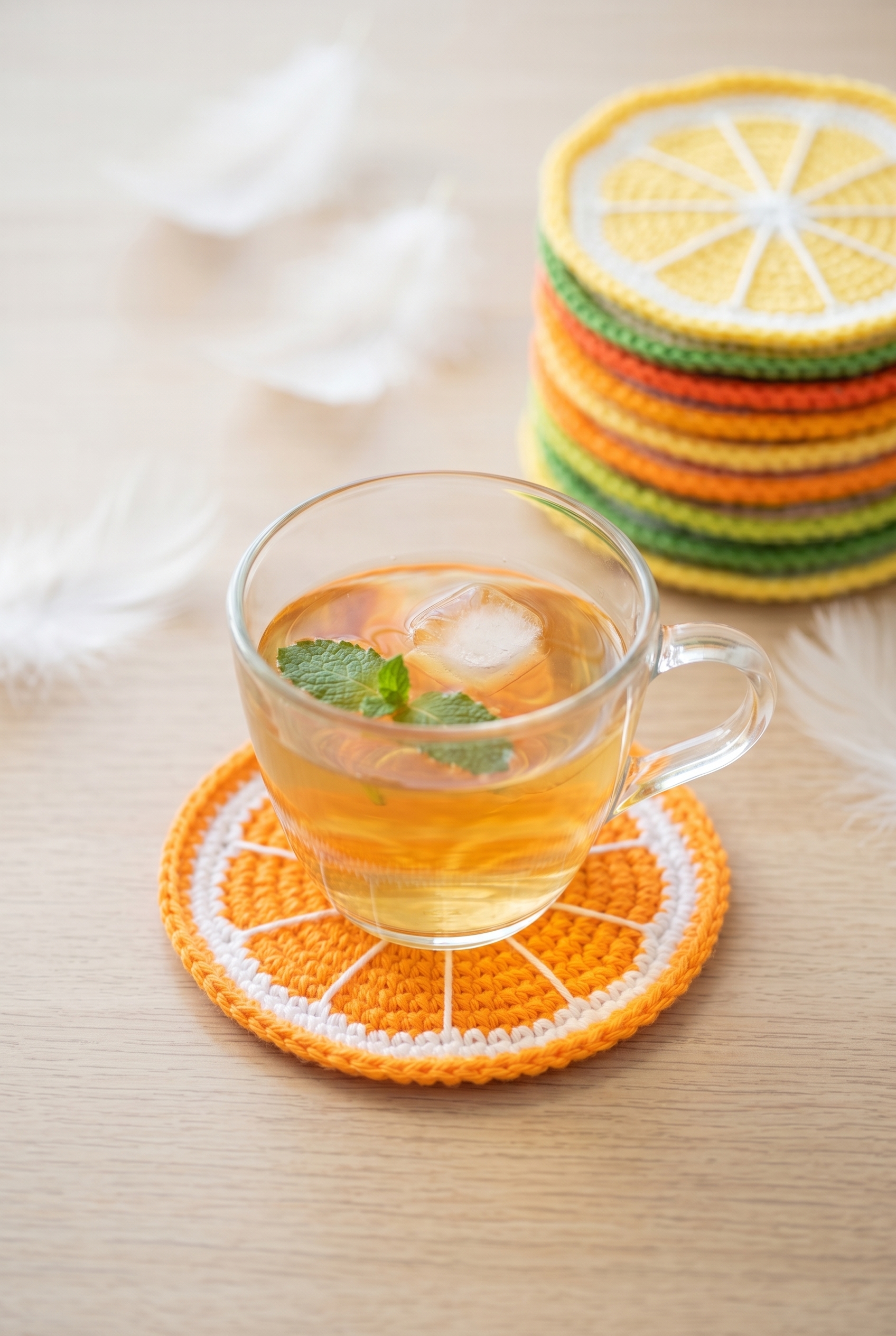
What I really like about this one is how much is going on in such a small footprint. The construction builds outward in rounds, and there's a point where you add the segment lines that just makes the whole thing click into place. It's one of those moments where you step back and think, oh yeah, that actually looks like a citrus slice. That payoff is a big part of why I keep recommending this pattern to people. It works beautifully as a gift, especially if you make a few in different colorways and bundle them together. A set of these on a coffee table is just a cheerful, practical thing to have around, and they're easy enough that you can make them while watching something on TV without losing your place.
Why You'll Love This Pattern
A small, clever design that works up fast and makes a genuinely impressive gift.
- Beginner friendly: This is rated easy, so if you're still building confidence with crochet, this is a low-stakes project with a high-reward finish.
- Quick to complete: Each coaster is small enough to finish in one sitting, which makes it a great pattern to reach for when you want a sense of accomplishment without a big time commitment.
- Great for gifting: A set of these is the kind of handmade gift that actually gets used. They're practical, they look intentional, and people always ask where they came from.
- Make a whole set: The design adapts easily across different colorways, so you can make a citrus-themed collection without learning a new pattern each time.
- Stash friendly: Each coaster uses a small amount of yarn, so this is a perfect pattern for using up scraps you've been holding onto.
Materials You'll Need
Seven colors sounds like a lot, but most of them are just small accent amounts.
- Fingering Weight 100% Mercerized Cotton: Fingering weight mercerized cotton is the right call here. The tight twist and smooth finish give you really clean stitch definition at this small gauge, and cotton holds its shape well in a coaster that's going to get regular use and washing. You'll need seven colors total: white, primrose, green yellow, sweet orange, royal orange, yellow gold, and forrest green. Exact yardage isn't listed in the pattern, but these are small coasters at under 4 inches across, so a partial skein of each color is more than enough. For the center color and outer round colors, you're really only working a handful of rounds per color.
- 2 mm crochet hook: A 2 mm hook keeps the fabric dense and tight, which matters for a coaster. You don't want gaps that let moisture through.
- Also needed: tapestry needle, scissors
Color Sequence & Yarn Changes
Each coaster follows the same three-color structure: white for Rounds 1 to 2, your chosen center color for Rounds 3 to 10, white again for Rounds 11 to 12, and then the outer color for Round 13. The center color is what changes depending on which citrus fruit you're making. Royal orange pulls double duty here as both the center color for grapefruit and the outer round color for both orange and grapefruit coasters, so if you're making a full set, that one color gets used more than the others.
At a Glance
A small, sturdy coaster worked in fingering-weight cotton that crochets up fast and lands just under 4 inches across.
| Skill Level | Easy |
| Pattern Gauge | Gauge is not critical for this project. Changing the yarn type or hook size can affect the size of the coaster. |
| Finished Size | Diameter: 3 ⅞" |
| Yarn Weight | 1 Super Fine / Fingering |
| Fiber | 100% Mercerized Cotton |
| Terminology | US |
Stitches & Abbreviations
Just a handful of basics here, nothing you haven't seen before.
- ch = chain
- inc = increase (work 2 sc in same st)
- MR = magic ring
- sc = single crochet
- sl st = slip stitch
- st(s) = stitch(es)
- * = repeat instructions between asterisks as directed
The Critical Details
Gauge isn't something to stress over with this one. Since it's a coaster and not a garment, a stitch or two off won't matter. That said, if you swap to a heavier yarn or a larger hook, the finished diameter will grow past that 3 ⅞" mark, and a lighter yarn or smaller hook will bring it in tighter. Both are fine depending on what you're going for. The mercerized cotton is a good fit here because it holds its shape and washes well, but the pattern will work with other fingering-weight cottons too.
Crochet Instructions
Here's how I work through this lemon coaster from center out, building the flat circle and then adding the fruit detail at the end.
Lemon Coaster
Start with Color A (White) for the first round, then switch to Color B, then back to Color A (White), and finally switch to Color C as noted through the rounds. The whole coaster is worked in rounds from a magic ring outward, with steady increases every round to keep it flat.
Round 1: MR, 6 sc. [6 sc]
Round 2: inc in each st around. [12 sc]
Round 3: (1 sc, inc) * 6. [18 sc]
Round 4: (2 sc, inc) * 6. [24 sc]
Round 5: (3 sc, inc) * 6. [30 sc]
Round 6: (4 sc, inc) * 6. [36 sc]
Round 7: (5 sc, inc) * 6. [42 sc]
Round 8: (6 sc, inc) * 6. [48 sc]
Round 9: (7 sc, inc) * 6. [54 sc]
Round 10: (8 sc, inc) * 6. [60 sc]
Round 11: (9 sc, inc) * 6. [66 sc]
Round 12: (10 sc, inc) * 6. [72 sc]
Round 13: (11 sc, inc) * 6. [78 sc]
End with sl st.
Finishing (Fruit Parts)
Use white yarn to embroider the segment lines that give the coaster its lemon-slice look. This is done with a needle after the main piece is complete.
Step 1: Use white yarn to make parts in the fruit: start in the center, then insert your needle in the first stitch of Round 11, go back through the center, and insert your needle in the 7th stitch. The center is your anchor point for each line — keep your tension consistent as you go so the segments sit evenly across the surface.
Care Instructions
These coasters are worked in 100% mercerized cotton, so they can go in the washing machine on a gentle cycle with cold water. Lay them flat to dry rather than tossing them in the dryer. The flat drying really does matter here because coasters this small can curl or warp if they tumble dry, and once the cotton sets that way it's a bit of a pain to get them lying flat again. If yours do come out slightly cupped, just dampen them and press them flat under a heavy book overnight.
Frequently Asked Questions
The white yarn stitched from the center out to Round 11 creates the segment lines you see on a real lemon slice. It's what makes the coaster read as a citrus fruit rather than just a yellow circle. I wouldn't skip it. The finishing step is simple: you start at the center, run the needle out to the first stitch of Round 11, come back through the center, and go out to the 7th stitch. That's it.
Yes. The construction is identical across all four. The only thing that changes is the color combination you choose for Rounds 3-10 and Round 13. Primrose gives you lemon, green yellow makes lime, sweet orange makes orange, and royal orange with a royal orange outer round gives you grapefruit. Same hook, same stitch counts, just different colors.
Those two white rounds form the pith ring you see on a real citrus cross-section, the pale layer between the fruit flesh and the outer rind. It's a small detail but it does a lot of visual work. Without it, the coaster just looks like a two-color circle. With it, it actually looks like a sliced lemon.
It will. The pattern notes this directly: changing the yarn type or hook size affects the finished diameter. Mine came out at 3 ⅞ inches using a 2 mm hook with fingering weight mercerized cotton. Go up a hook size and the coaster will be larger. For coasters, that's usually fine, but if you're making a set and want them to match, stick to the same hook and yarn throughout.
There are three color changes total: white to your center color at Round 3, back to white at Round 11, then to your outer color at Round 13. None of them happen mid-round, so you're just picking up a new color at the start of a round each time. Weaving in the ends with a tapestry needle afterward is the most time-consuming part, honestly.
Happy Crocheting
There's something really satisfying about making a whole set of these, lemon, lime, orange, and grapefruit lined up together on a table. They work up quickly enough that a full set of four is a very reasonable afternoon project, and they make a genuinely lovely handmade gift. If you make yours, I'd love to see them. Tag me on social media or drop a photo in the comments below. And if you're saving this for later, pinning it to your crochet board on Pinterest is a great way to find it again when you're ready to pick up your hook.


Leave a Reply